In the U.S., clog dancing or clogging, as it is sometimes known, takes its origins from square dancing. This is not where or how clogging began however. It is not quite clear but clogging may have been developed as long ago as the 1400s, which would make it one of the oldest types of dancing still in existence since its creation. Clog dancing is the official name but many people refer to it as clogging.
Before coming to be known as clogging or clog dancing, there was bluegrass dancing. This type of dance was done to music that often included the fiddle and was affectionately referred to as old time music for its many different steps and taps. African, German, Irish and English dances can all be somewhat identified in clogging, which is something of a mixture of moves from all of these backgrounds.
So what then, is clogging and how is it different from other types of dances? Clogging is a dance style that is accentuated by the type of shoes that are worn during the dance. The shoes are used to make a loud percussion noise with the toe or heel or in some cases both the toe and heel to make a rhythm. This rhythm or beat is often compared to the sounds that percussion instruments make and is the basis of clogging.
Other names for clogging that are used include flat-footing, buck dancing, jigging, foot-stomping and clog dancing. Each of these names shares that same definitive indications that clogging does, which is that the foot taps and heel clicks make this style of dance what it is. In Wales, clogging has taken to competition level and you can witness the dancers jumping high in the air over brooms.
Interested in a little bit of English history about clogging? Believe it or not, hard-soled shoes were required for individuals who worked at the weaving machines. They would tap their feet to keep them warm during working sessions. On the lunch period and after work, they would have unofficial competitions to see who had the best sounding percussion beats and rhythms. Now you know!
Here’s another interesting fact you may not know about clogging: It is the official state dance of both North Carolina and Kentucky. Ready to get clogging? There’s no time like the present to learn more about the fascinating dance that’s been around for a very long time. Take clog dancing shoes, for example. Clog dancing shoes often have taps on the toe and the heel so that they make a rhythm sound when you walk.
Clogging with these types of shoes makes it possible to hear the sound even if you are on carpet.
In the United States, dance crews are even taking clog dancing to a new level by competition on national television with this type of dance. So what is clogging? It’s a dance style that’s all over the world and enjoyed by people everywhere. With the right shoes and a little initiative, you too can be clogging your way to some good old fashioned enjoyable clog dancing before you know it!
We're staring down, not quite believing what we're seeing, at an athletic young man -- known to the cognizanti as a b-boy -- spinning on his head like a child's toy, a whirling top with arms, legs and torso.
A group of his friends are gathered in a loose circle around him, urging him on to ever greater, more elaborate, gyrations. Bass-heavy music, perhaps something by James Brown, whose 1969 song "Get On The Good Foot" inspired a lot of it, thumps out of a boom box.
We're witnessing the birth of the break dance, right?
Wrong. The spectacular power moves we're seeing are a somewhat recent innovation -- introduced by the legendary break dancers "Rock Steady Crew" in the late '70s and early '80s -- in what is actually a rather ancient art form with roots extending far wider and deeper than circa-1960s Bronx and Brooklyn street people.
Though some experts trace the lineage of the break dance back to the Brazilian Frevo, a Russian folk-dance-influenced form of martial-arts dance/march, it seems more likely that breakin', while it did originate in Brazil approximately 500 years ago, was invented by African slaves rather than native Brazilians or their Portuguese rulers.
Their dance, still popular today, became known as the Capoeira and is, as far as we known, the first nationally and internationally recognized dance to combine upright fighting and shadow-boxing moves with groundwork.
Mentally fast forward through the centuries, travel northward some thousands of miles, and check out the "uprockers" on the streets of Brooklyn, N.Y. in 1967. Though the Uprock (a.k.a. Rocking), which features, among many other movements, burns (aggressive hand thrusts) and jerks (martial-arts-inspired body motions) is not a break dance as we envision it now, it is the true soul-beat precursor of the Toprock, which took Uprock routines, added transition moves sometimes known as the six-step, and finished with groundwork.
Today's break dancing began to come of age in 1969 and 1970 when disc jockey, record producer and visionary Afrika Bambaataa convinced the members of the Bronx street gang of which he was then the warlord to challenge rival gangs to battle with macho dance routines in lieu of guns and knives.
As the '70s evolved, more emphasis was placed on groundwork involving stylized leg movements (so-called Floor Rock or Down Rock) and moves were added and deleted as tastes in funk, soul and early hip hop music evolved. Still, the basic form of both rocking and breakdance "cutting" contests remained the same until the "Rock Steady Crew" and the "Electronic Boogaloo Lockers" (later renamed the "Electric Boogaloos") literally hit the streets of New York with the spectacular hand-gliding, back-spinning, windmilling, and head-spinning ground moves that have since become synonymous with the word breakdance.
The dance gained in worldwide popularity during the '80s and '90s with break-dance moves being incorporated into movies and musical theater productions and European and Asian aficionados adding their own exuberant spins and whirls to the mix.
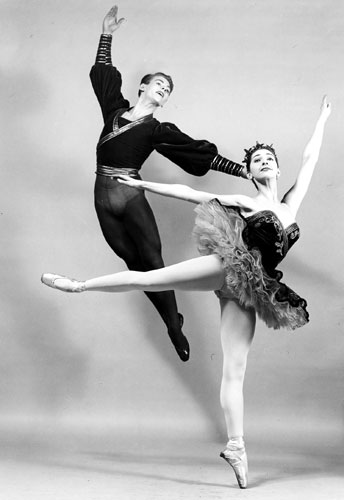
Ballet can tell a story, express an emotion, reflect a piece of music or simply showcase a choreographed series of movements.
At the heart of the classical dance form, however, is a bit of deception.
Reality tells us ballet is a physically brutal art that contorts its dancers into movements unnatural for the human body. It demands the utmost commitment, willpower and strength for, at most, a few decades dancing in the spotlight.
A well-executed ballet, however, transports the audience into a fantasy world where dancers defy gravity as they leap, maintain balance during dizzying spins, glide along their tiptoes and rise into the air as if light as a feather. A fine ballet is graceful and natural.
Though it may encompass incredible technicality and difficulty, a ballet's audience is only aware of its ability to personify or evoke emotion – from rage to jealousy to love – simply though the movements and the lines of the dancers' bodies.
It is this illusory fantasy world that has enthralled audiences for centuries.
A SELECT HISTORY OF BALLET
15th century:
Ballet originates as the court entertainment of Renaissance Italy, where the ruling aristocracy patronizes the arts and compete with each other by holding elaborate, costly parties featuring dance performances by their subjects.
16th century:
Catherine de Medicis, whose family ruled Florence, becomes the queen of France in 1547 and introduces the French court to the same kinds of entertainment she enjoyed in Italy. In 1581, her chief musician Balthasar de Beaujoyeux (whom she brought with her to France), creates what is considered the first ballet: Le Ballet comique de la Reine. At more than five hours long, the performance combines dance, an original orchestral work, sets, special effects, singing and spoken verse in its retelling of the ancient Greek myth of Circe.
17th century:
Louis XIV revives French interest in ballet. The Sun King greatly enjoys dance and – in his younger, fitter days – takes part in all the ballets given at his court. In 1661, he establishes the first ballet school, l'Académie Royale de Danse, to train dancers to perform for him. Around 1670, Pierre Beauchamps develops and codifies the five classic ballet positions at the Académie.
18th century:
Professionally trained French ballet dancers begin performing publicly around 1708 and similar dance troupes develop across the continent and eastward, including the acclaimed Russian Imperial Ballet of St. Petersburg, founded in 1738.
Though early dancers wore heavy, elaborate costumes and floor-length skirts, the increasingly skilled and technically accomplished dancers demand costumes that do not hide or interfere with their movements. Famed ballet dancer Marie Salle dons flowing robes inspired by the ancient Greeks while her rival and contemporary Marie Camargo shortens her skirt above her ankles, pulls on tights and removes the heels from her dancing shoes, effectively creating the ballet slipper.
Another set of rivals, choreographers Jean-Georges Noverre of France and Gasparo Angiolini of Italy, separately develop the dramatic style known as ballet d'action. Where early ballets were court entertainments that encompassed dance, theatre and singing, ballet d'action tells a story through dance steps and movements.
Noverre rejects opera-ballets and promotes ballet as a distinct art form. In his 1760 book Lettres sur la danse et sur les ballets, he criticizes the past style of dance that uses masks, wigs and bulky costumes to portray characters. He urges dancers to use only their bodies and faces to convey emotion and become the characters.
19th century:
Audiences begin to abandon ballets inspired by ancient Greek myths or dramas in favour of more romantic creations: fairy tales, love stories and escapist tales of dreamlike worlds or faraway lands.
Between 1820 and 1830, Italian dancer, teacher and choreographer Carlo Blasis writes extensively about ballet history and theory, and codifies the techniques of ballet.
The Romantic period influences ballet technique and fashion by inspiring pointe shoes, which lift female dancers and portray them as heavenly beings, and tutus, which complete free the legs. Female dancers gain importance over their male partners and the concept of the prima ballerina is born.
Italian choreographer Filippo Taglioni creates in 1832 what is considered the first Romantic ballet, La Sylphide. The star, his daughter Marie Taglioni, changes ballet fashion by dancing the role of the fairy-like being dressed in a lightweight, white, calf-length skirt and a top that bares her neck, arms and shoulders. Taglioni's dreamlike dance style is later rivalled by Austrian Fanny Elssler's strength as well as by fellow Italian Carlotta Grisi, star of 1841's Giselle.
In 1847, French-born dancer and choreographer Marius Petipa joins the Russian Imperial Ballet of St. Petersburg (which would become the Kirov Ballet) and helps the city become the ballet centre of the world. Petipa introduces a rigorously trained corps de ballet and creates some of the form's enduring works, including Don Quixote, The Sleeping Beauty, and restagings of Giselle, Coppélia, La Sylphide and Swan Lake. His roles showcasing lead ballerinas would continue to be among the most desired parts for more than 150 years.
20th century:
Sergei Diaghilev establishes the Ballets Russes in 1909, employing Michel (Mikhail) Fokine as choreographer. Fokine advocates dancers using their entire bodies – as opposed to separate gestures – to express emotion. Among others, he creates The Firebird in 1910 and Petrouchka in 1911, enlisting composer Igor Stravinsky to compose original music for the two.
Beginning around 1910, modern dance develops in Europe and North America. Declaring themselves independent of ballet, proponents often state vehement opposition to the classical form, calling it unnatural and a form of torture. Ballet enthusiasts disparage the newer form as "barefoot ballet."
During and after the 1917 Russian Revolution, some of the country's finest dancers emigrate to the West, join or develop troupes and open ballet academies. Their contributions to North America and Europe elevate ballet skill in countries like the U.S. and the U.K. to levels comparable to the acclaimed Russian troupes. These Russian dancers also dramatically increase worldwide audiences for ballet.
In the 1920s, dancer, choreographer and theorist Rudolf von Laban begins developing Labanotation, a system of dance notation used to record or make a blueprint of dance choreography. It eventually becomes a method of recording all body movement and is also used to analyse movement in sports and other areas.
Dancer and choreographer Rudolf Nureyev elevates traditional male dancer parts, transforming the simple porter function into significant, athletic and dynamic roles.
Following his move to the U.S. and a job choreographing at the American Ballet Company (the country's first major ballet school), former Ballet Russes dancer George Balanchine co-founds in 1948 what would become the world-famous New York City Ballet.
Choreography begins to explore more abstract dance techniques: without or with less of a dependency on plot or storyline, as an expression of the music, or as a study in a particular style of movement. This is expressed in works like 1957's Agon, one of many collaborations between Balanchine and Stravinsky.
By the 1970s, many ballet and modern dance groups have eliminated their rivalry and both begin to incorporate each other's techniques in new productions.
Many countries worldwide now have at least one ballet company and school.
A BRIEF HISTORY OF BALLET IN CANADA
Evelyn Hart has been with the Royal Winnipeg Ballet for more than 25 years. She knows the day is fast approaching when she will hang up her shoes and walk away from the only adult life she has ever known _ as an internationally acclaimed prima ballerina. (CP PHOTO)
Though touring performances had visited Canada since 1816, a Canadian professional ballet community only began in the 1930s when ballet teachers like Russian-born Boris Volkoff immigrated to Canada. In private studios, these pioneers trained Canadians who would go on to international acclaim, including Lynn Seymour, Patricia Wilde and Melissa Hayden. However, without proper ballet companies, these early stars were forced to dance outside of Canada.
In 1938, British-born ballet teachers Gweneth Lloyd and Betty Farrally established a club that would become, 11 years later, Canada's first professional ballet company. Initially named the Winnipeg Ballet, in 1953 the company became the first ballet company in the British Commonwealth to be allowed to use "royal" in its official title.
Seeing a growing audience for the form and spurred by the early success of the Winnipeg Ballet, ballet fans in Toronto enlisted British dancer and choreographer Celia Franca to establish the National Ballet of Canada in 1951. Within a decade, Franca also co-founded the National Ballet School of Canada, naming former British teacher Betty Oliphant as founding principal.
In 1958, Ludmilla Chiriaeff, a former Bolshoi Ballet prima ballerina, established Les Ballets Canadiens in Montreal. From there, smaller companies followed: the Alberta Ballet in the late 1960s, Ballet British Columbia in 1986 and more.
Despite being a relatively young community, in less than a century Canada has produced a score of internationally acclaimed dancers – including Veronica Tennant, Evelyn Hart, Karen Kain, Frank Augustyn and Rex Harrington – as well as world-renowned choreographers – including Brian Macdonald, Fernand Nault, Jean Grand-Maître, Norbert Vesak, John Alleyne, Mark Godden and James Kudelka.
The antique Argentine Tango was influenced by the Tango Habanera, which bears no resemblance to the Argentine Tango we know today. The Tango Habanera came about from two types of Tango: the Milonga with its influence in the guajira flamenca and the Tango andaluz or Tango flamenco. The Milonga was danced and played by country side people of Argentina. The Tango Habanera was an amalgamation of the Habanera and the Tango Andaluz or Tango Flamenco.
The rhythm of the guitars playing the Tango flamenco or andaluz could not be reproduced in orchestra instruments and with the piano, so the Tango andaluz or flamenco was modified with the habanera rhythm. The Tango Habanera was heard in 1883 but died towards the end of the century. The Tango Habanera has been entirely associated with the first forms of Argentine Tango. The flexing of the knees is associated to a dance called Candombe which was danced by the black people from Africa living in Buenos Aires. The male Candombe dancers danced with their knees flexed, to show their dance skills using walking steps (corridas) and turns.
A character who lived in the very early 1900's known as the "compadrito" created the straightened out forms of the antique Argentine Tango and invented the traditional figures of this dance. His dance style and stance supported his macho view of his world at those times. The "compadrito" ironically imitated the Candombe Dancers along with their flexing of the knees, walking steps, and turns. Old Tango people agree that the true forms of Argentine Tango Dance that we see today originated in 1938 - 1940 with the short-lived Tango singer Carlos Gardel. The Golden Age of Tango took place in in the late 1940's and early 1950's. World recording companies set up offices in Buenos Aires, which resulted in mass recordings of Tango orchestras and singers.
The antique Argentine Tango was never danced with castanets or with a flower.
Today in Buenos Aires or Río de la Plata, there are three forms of Argentine Tango: Salón, Fantasía, and one for scenario (stage). This has been the norm. With the internationalization of Tango, other forces have been shaping the Tango dance. The form known for stage, sometimes is referred as "for export", was aimed at English speaking people. Outside Argentina, people from North America had their first exposure with Stage Tango brought by the show and dance companies from Buenos Aires. At the end of the shows, the people asked for classes on what they had seen on stage. They wanted to learn what they saw on stage. Some of the dancers were available to teach, but knew only show routines. Other times seasoned dancers from Buenos Aires were asked to teach. They found it very difficult to explain that the correct form was to learn Argentine Tango from Buenos Aires rather than what they had seen at the show or on stage.
Dance is the human body movement. Through the motion of the human body is used to express ideas, feelings, and experiences of the artist to others. Distinctive feature is the motion of dance movements that have been processed from the aspect of energy, space and time.
There are two types of dance, namely non-traditional dance and dance -traditional. This includes traditional Indonesian dance is a primitive dance, folk dance, and dance classics. The three types of this dance ritual purposes, entertainment, and spectacle, while those who are included in non-traditional type of dance is a new creation dance, modern dance and contemporary dance. Dance characteristic of the new creation is a traditional dance that was renewed. Hallmark of modern dance and contemporary dance is a new invention in terms of theme, form and presentation of dance.
The form of modern dance and contemporary dance Indonesia is usually a combination of elements of local culture with elements of world culture. There is also a fully display the elements of world culture. Characteristic of Indonesia is to present contemporary dance theme, the form being famous, being in the spotlight today. If contemporary dance presents the themes and forms characteristic of being famous, being in the spotlight today, but modern dance is not necessarilypresent the themes and forms that are popular today.